
The Spring AC Tune-Up Checklist Every Albany Home Needs

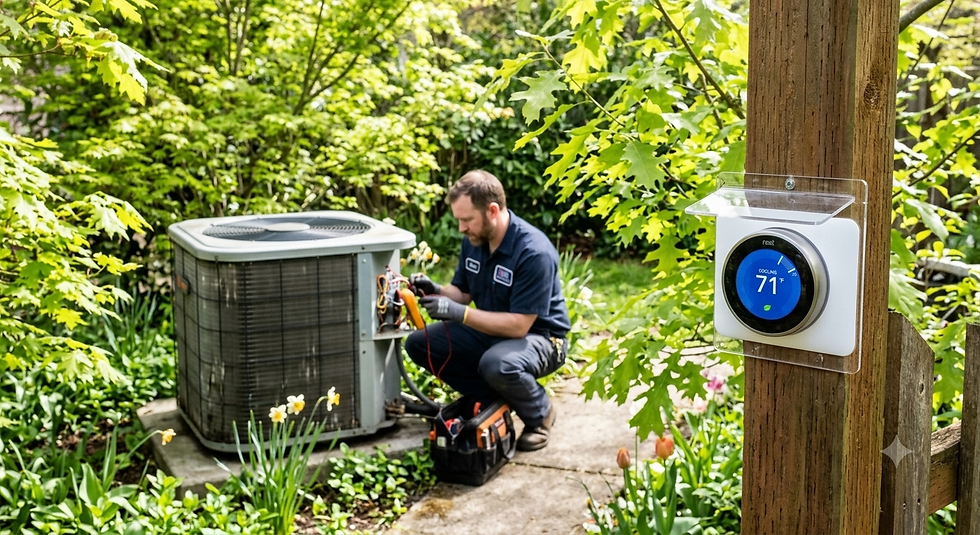
The first 90°F day in Albany hits like a switch. One week it's spring jacket weather, the next your kids are begging to turn on the AC. The trouble is, ACs that were fine in October sometimes refuse to start in May — and the busiest week for emergency AC calls every year is the first heatwave.
The fix is simple: a 10-point check before the first hot day. The first six items are DIY. The last four need a technician. Together they prevent the vast majority of preseason AC failures.
Things you can do yourself
1. Replace the filter.
If you haven't already, do it before turning on the AC. A clogged filter from the winter heating season will choke airflow and stress the system.
2. Clear the outdoor condenser unit.
Walk outside and look at the big metal box that sits beside your house. Over winter it has likely collected:
Leaves and twigs
Grass clippings from last fall's mowing
Spider webs on the fins
A nest, occasionally
Gently brush away debris. Then turn off the breaker for the unit, take a garden hose, and rinse the coils from the inside out (top to bottom). Don't use a pressure washer — you'll bend the fins. Standard hose pressure is plenty.
Make sure there's at least 2 feet of clear space on all sides for airflow.
3. Check the indoor unit's drain line.
Your AC produces water as it dehumidifies. That water drains through a small PVC pipe, usually to a floor drain or outside. Find the drain line at your indoor unit. If you see standing water in the pan beneath the unit, the line is likely clogged. A wet/dry shop vac can clear it from the outdoor end — or call us.
4. Look at the insulation on the refrigerant lines.
Outside your home, two copper lines run from the AC unit to the house. One is wrapped in black foam insulation. Over years, sun and weather degrade that foam. If it's cracked, falling off, or chewed by animals, your AC loses efficiency every time it runs. Replacement foam is cheap at any hardware store.
5. Test your thermostat batteries.
If you have a battery-powered thermostat (most non-smart models), winter is hard on batteries. Replace them in spring as a habit. A dying thermostat causes a wide range of weird AC behavior that's easy to misdiagnose.
6. Turn on the AC briefly while it's still cool out.
Pick a day in late April or early May when outdoor temperatures are above 60°F (running an AC when it's too cold outside can damage the compressor — don't do it in March). Set the thermostat 5 degrees below current room temperature. Listen for:
Clean startup with no banging or clicking
Cool air at the vents within a few minutes
Steady operation, not rapid on-off cycling
No unusual smells
If anything seems off, schedule a tune-up before the heatwave.
Things that need a technician
7. Refrigerant level check.
Refrigerant cycles through your AC in a closed loop. If levels are low, there's a leak — and refrigerant work requires EPA certification, specialized gauges, and (for older systems) careful handling of R-22, which is phased out and expensive. This isn't a DIY job.
8. Electrical inspection.
Capacitors, contactors, and the wiring inside the outdoor unit degrade with each summer of heat exposure. A failing capacitor is the most common preseason AC failure we see — and it shows no symptoms until the day you flip the AC on and nothing happens. A tune-up catches degraded electrical components before they fail.
9. Coil cleaning (deep clean).
The outdoor coils get a surface rinse from a hose, but the indoor evaporator coil — inside your air handler — accumulates a film of dust, mold, and particles over years. A technician can clean it properly with a chemical cleaner and a fin comb. A clean coil can improve efficiency by 10–15% on older systems.
10. Calibration and airflow balance.
A tune-up should include thermostat calibration, blower motor amp draw measurement, and a check that supply and return airflow are balanced. Tools like a manometer and amp clamp tell a technician whether your system is running at spec or limping along at reduced capacity.
The case for booking before May
Demand for AC service rises sharply in late spring. Our schedule for the first hot week is usually fully booked by mid-May. If you book a tune-up in April, you get:
Choice of time slots
A relaxed visit (technicians aren't rushing between emergencies)
Time to handle anything found before the heat arrives
Plan members get priority scheduling automatically.
One last thing — don't ignore weird sounds
If your AC made strange sounds at the end of last summer, "rest" doesn't fix them. They'll be louder this summer, then there'll be a breakdown. Bring it up when you book the tune-up.
Ready to schedule?
Call (838) 267-4484 or book online. Spring tune-up appointments fill quickly — we recommend booking by mid-April.


Comments