
Why Your AC Bill Spikes Every Summer (and How to Fix It)

Summer power bills used to be predictable in upstate New York. They're not anymore. Capital Region summers have gotten longer and hotter, and air conditioners that were efficient a decade ago are now running double-shifts they were never designed for. The good news: most "high AC bill" complaints we hear come down to one of five fixable problems.
If your July bill keeps rising while your usage habits haven't, here's where to look.
1. The filter
It sounds too simple to matter. It matters more than you think.
A dirty filter restricts airflow, which forces your blower to run longer to move the same amount of cool air through your home. Worse, restricted airflow over the indoor coil can cause the coil to freeze — and a frozen coil destroys efficiency completely while increasing the risk of compressor damage.
Check your filter monthly during cooling season. A standard 1-inch filter should be replaced every 1–3 months, more often if you have pets, allergies, or you're in a dusty area near construction. A clogged filter is the single most common cause of high summer bills we see.
2. The condenser unit is buried
Walk outside and look at your outdoor AC unit — the big metal box, usually beside the house. Is it surrounded by tall grass? Smothered by overgrown shrubs? Buried under leaves from last fall?
That unit needs to breathe. It works by transferring heat from inside your home to the outside air. If airflow around the unit is restricted, the system has to run longer and harder to do the same job. Clear at least 2 feet of open space on all sides. Gently rinse the coils with a garden hose (with the breaker off) once a year to remove pollen and dust.
3. Refrigerant is low
Your AC doesn't "consume" refrigerant the way a car burns fuel — refrigerant cycles through the system endlessly in a sealed loop. If levels are low, there's a leak. And a leaking AC runs constantly trying to reach a temperature it can't reach, while drawing maximum power the whole time.
Symptoms of low refrigerant:
AC runs constantly but never quite cools the house
Warm air coming from vents
Ice on the refrigerant lines outside
Hissing or bubbling sounds near the indoor unit
Refrigerant leaks are not a DIY fix. They require an EPA-certified technician to find the leak, repair it, and recharge the system properly.
4. The thermostat is fighting you
A thermostat in direct sunlight reads the wrong temperature and tells your AC to run longer than necessary. A thermostat near a heat-producing appliance (a TV, a lamp, a kitchen) does the same thing.
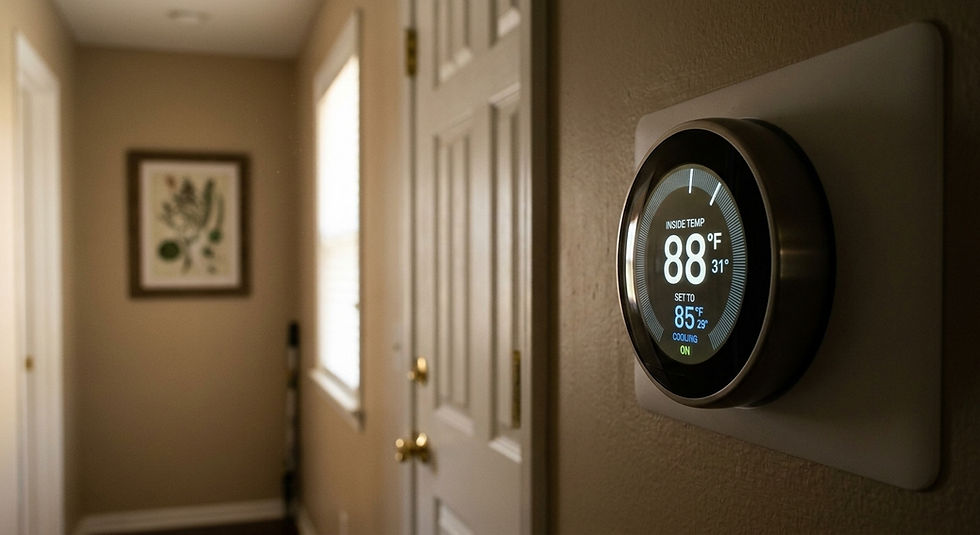
A poorly programmed smart thermostat can also drain efficiency. We see this often — homeowners install a Nest or Ecobee, never properly set their schedules, and end up cooling an empty house from 9 AM to 5 PM. Smart thermostats are powerful when programmed thoughtfully and money-burners when ignored.
If your thermostat is in a bad location, a relocation by a technician costs less than one month of inflated cooling bills. If yours just needs setup help, we can do that on a maintenance visit.
5. Your AC is undersized — or way oversized
Counterintuitively, an oversized AC is worse than an undersized one. Oversized units cool the room temperature quickly, then shut off — but they don't run long enough to remove humidity. The result is a cool, clammy home that feels warmer than the thermostat says, so the homeowner keeps lowering the setpoint, and the cycle repeats.
If your home feels muggy even when the AC is running, or if your AC cycles on and off every few minutes, sizing is likely the issue. We perform Manual J load calculations during installation specifically to prevent this — but if you inherited an existing system, it may be wrong for your home.
Fixing high AC bills — the practical order
Start cheap and work up:
Change the filter (free or under $30)
Clear and rinse the outdoor unit (free)
Book a tune-up — we'll catch refrigerant issues, low charge, dirty coils, and electrical wear that's costing you money ($)
If problems persist, consider system sizing analysis ($$)
A proper AC tune-up before peak season usually pays for itself in lower bills the same summer. Call (838) 267-4484 or book online.
Comments