
7 Signs Your Furnace Won't Survive Another Albany Winter

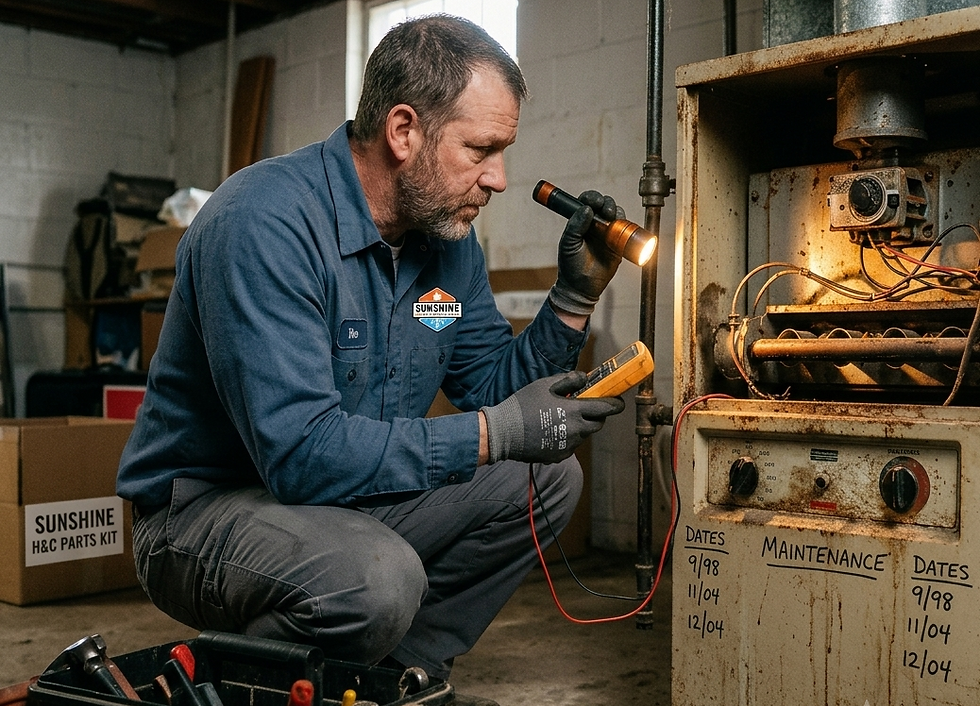
When the mercury drops to single digits in January, and your furnace decides to quit, the cost isn't just the repair bill — it's the frozen pipes, the emergency hotel stay, and the four-hour wait for someone to make it through the snow. Furnaces almost never fail without warning. The trick is knowing what to look for and acting before the cold snap, not during it.
After fifteen years of servicing furnaces across Albany, Schenectady, Troy, and the surrounding towns, we've seen the same warning signs over and over. Here are the seven we'd never ignore in our own homes.
1. Your furnace is over 15 years old
Modern gas furnaces are built for a useful life of 15 to 20 years. Anything past that, and you're rolling the dice every winter. The bigger problem isn't just failure — it's efficiency. A 25-year-old furnace might be running at 65% efficiency, meaning 35 cents of every fuel dollar is going up the flue. A new high-efficiency model runs at 95% or higher. The math gets harder to ignore every year.
If your furnace is approaching or past 15, get an honest assessment now. We'd rather replace your furnace in October than chase a no-heat call in February.
2. Heating bills are creeping up year after year
Compare the cost-per-degree-day on this winter's heating bill to two or three winters ago, with the same thermostat settings. If costs are climbing without a clear utility rate change, your furnace is working harder for the same result. That's a leading indicator of a system on its way out.
3. Yellow or flickering burner flame
A healthy gas burner flame is steady and blue. If you see a yellow flame, a wavering flame, or a flame that won't stay lit, the burners are likely dirty, the heat exchanger may be cracked, or combustion isn't complete. Yellow flames also indicate carbon monoxide risk. This is a warning to call a technician before using the furnace again, not later.
4. Banging, popping, or rattling noises
Furnaces are designed to run quietly. New noises mean something is wrong:
Banging on startup: delayed ignition — burners are firing late after gas has accumulated
Rattling or shaking: loose ductwork, a failing motor mount, or a deteriorating heat exchanger
Squealing: belt or bearing problems in the blower
Constant popping: ductwork expanding from over-pressurised airflow
None of these gets better on their own. They get more expensive.
5. Uneven heating room to room
If your bedrooms are 60°F and your living room is 75°F at the same thermostat setting, the system is no longer distributing heat properly. The cause could be ductwork problems, a failing blower, or — in older systems — a furnace that's lost the capacity to heat the whole home. A tune-up can sometimes correct it. Other times, it's a sign the furnace itself is undersized for the home it's now trying to heat.
6. Frequent repairs in the last two seasons
There's a rule of thumb in HVAC: if the cost of a single repair is more than a third of the cost of a replacement — or you've had two or more significant repairs in the past two heating seasons — replacement is usually the smarter move. You're approaching the point where every fix is a band-aid on a system winding down.
7. Your carbon monoxide detector goes off
Stop reading. If your CO detector is alarming, get everyone outside, then call 911 or your gas utility. A faulty furnace with a cracked heat exchanger or blocked flue can leak carbon monoxide into your home — and CO is colorless, odorless, and deadly. After you're safe, call us for an inspection. We never reuse equipment after a CO event without a full safety check.
What to do next
If you saw your furnace in two or more of the above, it's worth a conversation now — before the first arctic blast. We give honest repair-vs-replace assessments with real numbers, including projected fuel savings if a new high-efficiency unit makes sense for your home.
Call (838) 267-4484 or request a free estimate online. Same-day appointments are usually available outside of peak winter.
Comments